 |
 |
OZ ATV :: The Australian ATV Forum
Australia's Largest ATV Forum
|
|
|
|
|
|
|
|
|
|
|
HaggLE
Roostin Away
Joined: 16 Mar 2009
Posts: 511
Location: Newcastle
|
 Posted: Thu May 09, 2013 5:32 am Post subject: Posted: Thu May 09, 2013 5:32 am Post subject: |
  |
|
| Ben, ask you friend at the track if you can camp at the track overnight, that's pretty common in the road racing circles that I'm familiar with... |
|
| |
|
|
|
|
|
|
|
|
Sponsor
|
|
|
|
|
|
|
|
|
ForeverThreeWheels
The Day Starts With OZATV !
Joined: 18 Nov 2008
Posts: 1742
Location: Maitland
|
| Posted: Thu May 09, 2013 6:22 pm Post subject: |
|
|
| HaggLE wrote: | | Ben, ask you friend at the track if you can camp at the track overnight, that's pretty common in the road racing circles that I'm familiar with... |
We've gotta move anyway but next time we go I'm gonna camp up the road at Nundle and do some prospecting.
_________________
 |
|
| |
|
|
|
|
|
|
|
|
ForeverThreeWheels
The Day Starts With OZATV !
Joined: 18 Nov 2008
Posts: 1742
Location: Maitland
|
| Posted: Sat May 11, 2013 12:35 am Post subject: |
|
|
I got a call from Sladey today, he asked me if our mate that fell off was ok. I told him yeah we're tough, we just walk it off. I asked him why he asked and he said that MA had contacting him, apparently a quad rider had a crash out that way and is now a paraplegic.
I thanked him again for letting us ride etc and he said he looks forward to seeing us back there again. I told him we'd probably be back in a couple months as its a fair drive etc.
Well done to everyone for leaving a good impression.
_________________
|
|
| |
|
|
|
|
|
|
|
|
Mart 300r
Roostin Away

Joined: 02 Jun 2008
Posts: 944
|
| Posted: Sat May 11, 2013 12:58 pm Post subject: |
|
|
Geeeezzz that's no good to hear about the quad rider.
The people were so nice about having us there I cant wait to get back up there.I wonder how we go about contacting MA to talk to em about letting us race even under a vintage thing or something???
I just went on MA website I reckon benny you write one of you suck up emails to them lol your good at it.Im about as usefull as tits on a bull when it comes to writing lol.
_________________
1984 ATC 300R, 1986 TRX 500R,1984 ATC 200X, ATC 70 WITH CUSTOM LAYDOWN 250R ENGINE, 125CC CUSTOM THUMPSTER TRIKE |
|
| |
|
|
|
|
|
|
|
|
ForeverThreeWheels
The Day Starts With OZATV !
Joined: 18 Nov 2008
Posts: 1742
Location: Maitland
|
|
| |
|
|
|
|
|
|
|
|
ForeverThreeWheels
The Day Starts With OZATV !
Joined: 18 Nov 2008
Posts: 1742
Location: Maitland
|
| Posted: Sat May 11, 2013 8:33 pm Post subject: |
|
|
This has all been taken from the 2013 Motorcycling Australia Manual of Motorsports.
These are some of the rules and regulations that I believe are relavent to us trying to change/modify in order for us to race.
MOTORCYCLE CHAMPIONSHIP CATAGORIES
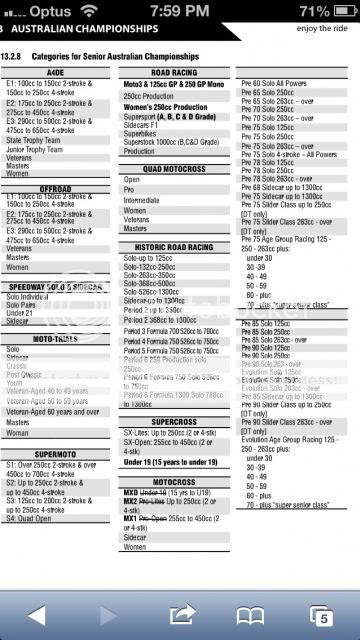
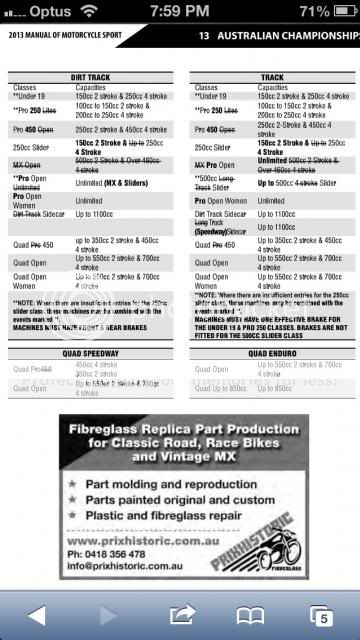
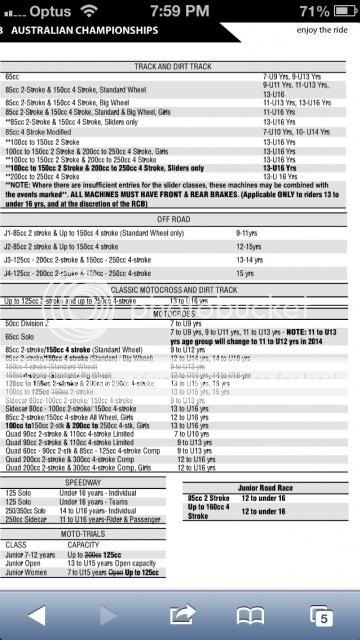
DISCIPLINE/TRACK CATAGORIES
Under section 20 of the 2013 MA Manual of Motorsports "Speedway", there is no mention of quads. Only Junior and Senior Solos and Sidecars.
CLASSIC MOTOCROSS & POST CLASSIC
MOTOCROSS & DIRT TRACK
AN OVERVIEW
Classic Motocross and Dirt Track applies to events Pre
60 Class up to and including the Pre 78 Class.
Post Classic Motocross and Dirt Track applies to
Evolution, pre 85 and the pre 90 classes. The Classic
and Post Classic divisions will be run separately at
the Australian Championships however consideration
will be given to submissions to run both events under
special circumstance.
These events will be described at the national
Championships as The Australian Classic Motocross
Championships and the Post Classic Australian
Championships.
18.1 PROTECTIVE CLOTHING - CLASSIC
MX & DIRT TRACK
18.1.0.1 No competitor may practice, start or
compete under this Chapter unless
wearing the following protective
equipment and clothing:
18.1.1 Helmet
18.1.1.1 An approved and correctly fitting helmet
which must:
a) Carry the Standards Association of
Australia “AS 1698” label, or
b) Be approved under Rule 01.69
& 01.70 of the Road Racing FIM
Technical Rules [see Appendix 1]
18.1.2 Clothing
18.1.2.1 Trousers of leather or synthetic material of
similar durability.
18.1.2.2 Trousers of other than leather must be
non-combustible and be fitted with a
lining,
18.1.2.3 A jersey which must be:
a) Made of close knit fabric of natural or
synthetic fibre, and
b) Must be a snug fit and provide
protection against abrasion to the
body and arms.
18.1.2.4 Dirt track riders must wear a commercially
manufactured back protector, which
continuously covers the back area
between the collar line and the base of
the spine.
18.1.3 Footwear
18.1.3.1 Boots which must be:
a) Of recognised Motocross type for
Motocross and of Dirt Track type for
Dirt Track,
b) Constructed of leather, plastic or
other similarly durable material, and
c) Of a length that must at least cover
¾ of the length of the lower leg, with
the rider in a racing position on the
machine.
18.1.4 Gloves
18.1.4.1 Gloves of leather or other material of
similar or greater durability.
18.1.5 Goggles and Visors
18.1.5.1 Eye protection, including spectacles,
protective goggles, helmet visors and/or
‘tear-offs’ must be worn provided:
a) Eye protectors and spectacles are
made of non-shattering material,
b) Eye protectors which cause visual
disturbance are not to be used,
c) Metal or perspex face shields are not
used,
d) Eye shades or peaks are of a flexible
material.
18.1.6 Hair and Jewellery
18.1.6.1 Hair longer than shoulder length must be
confined in the helmet or jacket.
18.1.6.2 Body jewellery is to be removed or
securely covered with tape prior to
competition.
18.1.7 Footwear in pits
18.1.7.1 Closed footwear must be worn in the pit
area at all times.
CLASSIC MOTOCROSS & POST CLASSIC
MOTOCROSS & DIRT TRACK
18
165
2013 MANUAL OF MOTORCYCLE SPORT
18.2 ELIGIBILITY
18.2.1 Eligible Machines
18.2.1.1 Only machines conforming to the following
requirements will be accepted.
18.2.1.2 The onus of proof of eligibility shall rest
wholly upon the rider or entrant of the
machine. Service and Parts Manual
publication dates are not proof of eligibility.
18.2.2 Classes
18.2.2.1 The following classes shall be recognized:
Classic MX and Dirt Track
Pre 60 solo all powers
Pre 65 solo 250cc
Pre 65 solo 263cc – over
Pre 70 solo 250cc
Pre 70 solo 263cc – over
Pre 75 solo 125cc
Pre 75 solo 250cc
Pre 75 solo 263cc – over
Pre 75 solo 4-stroke all powers
Pre 78 solo 125cc
Pre 78 solo 250cc
Pre 78 solo 263cc- over
Pre 68 Sidecar up to 1300cc
Pre 75 Sidecar up to 1300cc
Pre 75 Slider Class up to 250cc (DT only)
Pre 75 Slider Class 263cc – over (DT only)
Pre 75 Age Group Racing 125 – 250 –
263cc plus
g) under 30
h) 30 – 39
i) 40 – 49
j) 50 – 59
k) 60 – plus
l) 70 – plus “super senior class”
Post Classic MX and Dirt Track
Pre 85 solo 125cc
Pre 85 solo 250cc
Pre 85 solo 263cc – over
Pre 90 solo 125cc
Pre 90 solo 250cc
Pre 90 solo 263cc – over
Evolution solo 125cc
Evolution solo 250cc
Evolution solo 263cc – over
Pre 85 sidecar up to 1300cc
Pre 90 Slider Class up to 250cc
Pre 90 Slider Class 263cc – over
Evolution Age Group Racing 125 – 250 –
263cc plus
f) under 30
g) 30 – 39
h) 40 – 49
i) 50 – 59
j) 60 – plus
18.2.3 Age Groups
18.2.3.1 Age is determined as at the date of the
meeting or 1st round for series events.
18.2.3.2 Age grouping applies to competition Pre-
1975 in the Classis Class and Evolution in
the Post Classic Class.
18.2.3.3 Age groups are:
a) Under 30,
b) 30 – 39,
c) 40 – 49,
d) 50 – 59,
e) 60 – plus
f) 70 plus pre 75 only
18.2.3.5 Super Senior class Pre-1975.
a) All powers,
b) Rider age 70 plus,
c) Australian Championship will be
awarded regardless of number of
entrants.
18.3 FUEL - CLASSIC MX & DIRT TRACK
18.3.1 Fuel for CMX & CDT racing must be:
a) Pure Methanol with no additives
other than lubricating oil, or,
b) Unleaded fuel that is no more than
100 RON and meets rule 12.9.5.1,
c) Which contains no additives other
than those added at the point of
manufacture except for lubricating oil,
or,
d) Be a brand of fuel homologated by
MA that is compatible with the “Fuel
Quality Standards Act 2000”, or,
e) Leaded fuel provided that the fuel is
purchased from suppliers approved
by Environmental Australia.
18 CLASSIC MOTOCROSS & DIRT TRACK
166
enjoy the ride
18.4 MACHINE AND CLASS
IDENTIFICATION - CLASSIC MX &
DIRT TRACK
18.4.01 Number plates shall be either oval or
rectangular and in the following colours:
CAPACITY BACKGROUND
COLOUR
FIGURE
COLOUR
Up to 125cc Black White
126cc to 250cc Dark Green White
251cc and over Canary Yellow Black
18.4.02 Class Identification
18.4.02.1 A letter will be:
a) Used to identify the class of the
machine,
b) Placed on the left side of all 3 race
plates,
c) 50mm high, and in upper case,
d) The same colour as the race number.
18.4.02.2 Identification letters for each class are:
a) Pre-1960 “A”.
b) Pre-1965 “N”.
c) Pre-1970 “H”.
d) Pre-1975 “X”.
e) Pre-1978 “Z”.
f) Evolution “E”.
g) Pre-1985 “Y”
h) Pre-1990 ”W”
18.5 TABLES OF MACHINES AND
COMPONENTS
8.5.1 Acceptable Machines and Components
- Pre 60.
18.5.1.1 Acceptable for the pre 60 class are
machines and components built up to
and including the 1959 model. The only
exception to this GCR is where the model
remains unaltered after this date.
18.5.1.2 frames of any manufacture are
acceptable within the suspension criteria
and considerate of the era.
18.5.1.3 Front wheel travel will not exceed 178mm
(7 inches) rear wheel travel will be limited
to 102mm (4 inches) measured at the
axle. Rear shock absorbers will be in
the original position using the original
mounting points.
18.5.1.4 Plastic and fibreglass is not permitted
18.5.1.5 Engines and gearboxes must remain
externally unchanged.
18.5.1.6 Period carburettors or Amal Mk1 Concentric.
18.5.1.7 Exhaust may be modified but must follow
the original lines and be fitted with an
effective muffler.
18.5.1.8 Folding footrests must be fitted
18.5.1.9 Countershaft sprocket covers will be
fitted.
18.5.2 Acceptable Machines and Components
- Pre 65.
18.5.2.1 Acceptable for the pre 65 class are
machines and components built up to
and including the 1964 model. The only
exception to this rule is where the model
remains unaltered after this date.
18.5.2.2 Frames of any manufacture are
acceptable within the suspension criteria
and considerate of the era.
18.5.2.3 Front wheel travel will not exceed 178mm
(7 inches) rear wheel travel will be limited
to 102mm (4 inches) measured at the
axle. Rear shock absorbers will be in
the original position using the original
mounting points.
18.5.2.4 Engines and gearboxes must remain
externally unchanged.
18.5.2.5 Carburettors; any type of pre 75 round
slide may be used.
18.5.2.6 Exhaust may be modified but must follow
the original lines and be fitted with an
effective muffler.
18.5.2.7 Folding footrests must be fitted.
18.5.2.8 Countershaft sprocket covers will be
fitted.
18.5.3 Acceptable Machines and Components
- Pre 70
18.5.3.1 Acceptable for the pre 70 class are
machines and components built up to
and including the 1969 model. The only
exception to this rule is where the model
remains unaltered after this date.
18.5.3.2 Front wheel travel will not exceed 178mm
(7 inches) rear wheel travel will be limited
to 102mm (4 inches) measured at the
axle. Rear shock absorbers will be in
the original position using the original
mounting points.
18.5.3.3 Engines and gearboxes must remain
externally unchanged.
18.5.3.4 Carburettors; any type of pre 75 round
slide may be used.
18.5.3.5 No reed valves permitted.
18 CLASSIC MOTOCROSS & DIRT TRACK
167
2013 MANUAL OF MOTORCYCLE SPORT 18 CLASSIC MOTOCROSS & DIRT TRACK
18.5.3.6 Exhaust may be modified but must follow
the original lines and be fitted with an
effective muffler.
18.5.3.7 Folding footrests must be fitted.
18.5.3.8 Countershaft sprocket covers will be
fitted.
18.5.3.9 Yamaha XS1 and XS650 engines are
eligible.
18.5.3.10 Acceptable follow on models pre 70
a) AJS Stormer 250,
b) Greeves griffon models,
c) Yamaha AT1, DT1, CT1, RT1 pre
reed block.
18.5.4 Acceptable Machines and Components
- Pre 75.
18.5.4.1 Acceptable for the pre 75 class are
machines and components built up to
and including the 1974 model. The only
exception to this rule is where the model
remains unaltered after this date.
18.5.4.2 Front wheel travel will not exceed 178mm
(7 inches) rear wheel travel will be limited
to 102mm (4 inches) measured at the
axle. Rear shock absorbers will be in
the original position using the original
mounting points.
18.5.4.3 Engines and gearboxes must remain
externally unchanged.
18.5.4.4 Carburettors; any type of pre 75 round
slide may be used.
18.5.4.5 XS1 and XS650 engines are eligible.
18.5.4.6 Exhaust may be modified but must follow
the original lines and be fitted with an
effective muffler.
18.5.4.7 Folding footrests must be fitted.
18.5.4.8 Countershaft sprocket covers will be
fitted.
18.5.4.9 Acceptable follow on models pre 75
a) Honda CR125M1, XL250K1,
XL350K1, MT250 and MT125,
b) Yamaha YZ360B, DT250B,
c) Suzuki TS400 (all).
18.5.5 Acceptable Machines and Components
- Pre 78.
18.5.5.1 Acceptable for the pre 78 classes are
machines and components that are
limited to the 1975, 1976, 1977 models
alone. The only exception to this rule is
where the model remains unaltered after
this date.
18.5.5.2 Front wheel travel will not exceed 229mm
(9 inches) rear wheel travel will be limited
to 229mm (9 inches) measured at the
axle. Rear shock absorbers will be in
the original position using the original
mounting points.
18.5.5.3 Engines and gearboxes must remain
externally unchanged.
18.5.5.4 Carburettors; any type of pre 78 round
slide may be used.
18.5.5.5 Exhaust may be modified but must follow
the original lines and be fitted with an
effective muffler.
18.5.5.6 Folding footrests must be fitted.
18.5.5.7 Countershaft sprocket covers will be
fitted.
18.5.5.8 Acceptable follow on models pre 78
a) CZ 125 1978, CZ400 1978,
b) Montessa VB (must comply to
suspension limits),
c) Yamaha TT500 1978.
18.5.6 Acceptable Machines and Components
-Evolution Class.
18.5.6.1 Bikes will be OEM (original equipment
manufacture).
18.5.6.2 Modifications converting later equipment
to comply will not be allowed.
18.5.6.3 All components will be of the period the
machine was manufactured:
a) No linkage suspension,
b) No disk brakes,
c) air cooled motors.
18.5.6.4 Carburettors; period flat slide carburettors
and any round slide carburettor may be
used
18.5.6.5 Engines and gearboxes must remain
externally unchanged.
18.5.6.6 Exhaust may be modified but must follow
the original lines and be fitted with an
effective muffler.
18.5.6.7 Folding footrests must be fitted.
18.5.6.8 Countershaft sprocket covers will be
fitted.
18.5.6.9 The handlebars must be equipped
with a protection pad on the cross bar.
Handlebars not fitted with a cross bar
must be equipped with a protection pad
located in the middle of the handlebars
covering the handlebar clamps.
168
enjoy the ride
18.5.7 Acceptable Machines and Components
- Pre 85.
18.5.7.1 Acceptable for the pre85 class are
machines and components built up to
and including the 1984 model. The only
exception to this rule is where the model
remains unaltered after this date.
18.5.7.2 Carburettors; period flat slide carburettors
and any round slide carburettor may be
used.
18.5.7.3 Engines and gearboxes must remain
externally unchanged.
18.5.7.4 Exhaust may be modified but must follow
the original lines and be fitted with an
effective muffler.
18.5.7.5 Folding footrests must be fitted.
18.5.7.6 Countershaft sprocket covers will be
fitted.
18.5.7.7 The handlebars must be equipped
with a protection pad on the cross bar.
Handlebars not fitted with a cross bar
must be equipped with a protection pad
located in the middle of the handlebars
covering the handlebar clamps.
18.5.8 Acceptable Machines and Components
- Pre 90.
18.5.8.1 Acceptable for the pre90 class are
machines and components built up to
and including the 1989 model. The only
exception to this rule is where the model
remains unaltered after this date.
18.5.8.2 Carburettors; period flat slide carburettors
and any round slide carburettor may be
used.
18.5.8.3 Engines and gearboxes must remain
externally unchanged.
18.5.8.4 Exhaust may be modified but must follow
the original lines and be fitted with an
effective muffler.
18.5.8.5 Folding footrests must be fitted.
18.5.8.6 Countershaft sprocket covers will be
fitted.
18.5.8.7 The handlebars must be equipped
with a protection pad on the cross bar.
Handlebars not fitted with a cross bar
must be equipped with a protection pad
located in the middle of the handlebars
covering the handlebar clamps.
18.6 FRAMES & PARTS - SIDECARS -
CLASSIC MX & DIRT TRACK
18.6.01 For the Pre-1975 classes, all performance
parts except frames must be manufactured
before 31st December 1974 and comply
with the following:
a) Wheel track measurement, taken
between the longitudinal centres of
the rear and sidecar wheels must be
between 810mm and 1100mm,
b) The minimum ground clearance must
be 175mm unladen,
c) The maximum lean of the motorcycle
at saddle height must be 50mm,
d) The dimensions of the sidecar
baseboard in plain view, taken from a
line drawn no further rearwards than
the lowest point of the front downtube
to the forward most point of the
sidecar wheel tyre and terminating no
further rearwards than a line drawn at
right angles to the machine from the
rearmost point of the rear tyre, must
be:
i) At least 760mm long adjacent to
the sidecar wheel,
ii) At least 300mm wide with at least
25mm radius to all corners.
e) There must be no more than 50mm
between baseboard and motorcycle
and between baseboard and sidecar
wheel. The baseboard must be
arranged so as not to allow the
passenger’s feet to be trapped,
f) There must be no less than 4 sidecar
attachment points,
g) Stirrup fitting for the passenger’s feet
are not permitted,
h) Handholds:
i) Must be finished with a loop of at
least 100mm,
ii) Must not project beyond a line
taken with the outer edge of the
sidecar mudguard or bodywork,
iii) Adjacent to the nose section of
the sidecar and less than 200mm
from the track surface must be at
an angle of at least 45° from the
horizontal.
18 CLASSIC MOTOCROSS & DIRT TRACK
169
2013 MANUAL OF MOTORCYCLE SPORT
i) The rear end of the rear wheel
mudguard must terminate not more
than 65° above a horizontal line
drawn through the rear wheel axle
and be valanced to baseboard level
on the inside,
j) The sidecar mudguard must cover
at least 135° of the periphery of the
wheel and be valanced to baseboard
level on the inside,
k) No machine may be fitted with scoop
or paddle tyres,
l) Suspension travel must not exceed:
i) 152mm (6”) measured at the
front axle,
ii) 102mm (4”) at the rear axle.
m) Rear tyre width must not exceed
135mm (5.3”),
n) Brakes:
i) Front - single caliper, single
disc may be fitted provided they
were manufactured before 31st
December 1974,
ii) Rear - rear disc brakes may be
used provided they were fitted
as standard equipment for that
particular combination.
18.6.02 Pre-1985 is for sidecars constructed
with motors manufactured before 31st
December 1984.
18.7 ENGINES - SIDECARS - CLASSIC MX &
DIRT TRACK
18.7.01 For the Pre-1975 class, all performance
parts must be manufactured before 31st
December 1974 and comply with the
following:
a) Only round-slide carburettors
manufactured within the relevant
period may be used,
b) Engine capacity must be:
i) Up to 1300cc,
ii) Within the tolerances in GCR
12.4.
18.7.02 Pre-1968 will be for sidecars constructed
from road going frames and all major
components are those commercially
available within the period.
18.7.03 The following table sets out the machines
and components which eligibility
scrutineers may use as a guide in
determining eligibility. Entrants must
prove eligibility of machines not listed
below.
MAKE MODEL(S)
Wasp All up to and including RT2, RT8 and
RT14
Hagon All up to 31st December 1974
Yamaha XS 650 all models
Honda Any K series
Norton All 750, 850 to Mk2 only
Westlake All up to 850cc and 31st December
1974
Triumph All up to T150
CCM All BSA B50 based models
18.8 FRAME & PARTS SLIDER CLASS
18.8.01 The frame must:
a) Have a conventional swing arm
rear suspension with twin shock
absorbers,
b) Have a front wheel diameter of 23”,
c) Have a rear wheel diameter of 19”,
d) Have rear tyres with a maximum
tread pattern depth of 8mm,
e) Not be fitted with leading-link front
forks.
18.8.02 Engine Specifications - Solo.
18.8.02.1The engine must:
a) Be a single cylinder,
b) When four stroke be 2- valve push
rod operation, c) Have a single
spark plug,
d) Be vertical in the chassis,
e) Be fitted with a round slide carburettor,
f) Be a period two stroke compatible
with class entered.
18.8.03 Gearbox - Classic Long Track
18.8.03.1The gearbox must have at least 2 gears.
18.8.04 Frames - Sidecars
18.8.04.1 Conventional type frames as used prior to
31st December 1976 must be used.
18.8.05 Engine Specifications - Sidecars
18.8.05.1 Engines must have been manufactured
before 31st December 1976.
20 DIRT TRACK
20.1 PROTECTIVE CLOTHING - DIRT TRACK
20.1.0.1 No competitor may practice, start or
compete in any Dirt Track competition
unless wearing the following protective
equipment and clothing:
20.1.1 Helmet
20.1.1.1 An approved and correctly fitting helmet
which must:
a) Carry the Standards Association of
Australia “AS 1698” label; or
b) Be approved under Rule 01.69
& 01.70 of the Road Racing FIM
Technical Rules [see Appendix 1].
20.1.2 Minimum requirements of Protective
Clothing:
Rider responsibility: It is the responsibility
of the rider to select a helmet and apparel
that will provide appropriate protection.
Although MA approves materials, MA does
not endorse or guarantee specific products
or manufacturers. Riders must rely on their
own judgment in the selection of helmets
and apparel for protection and durability.
20.1.2.1 Trousers of leather or synthetic material of
similar durability.
20.1.2.2 Trousers of other than leather must be
non-combustible and be fitted with a
lining,
20.1.2.3 A jersey which must be:
a) Made of close knit fabric of natural or
synthetic fibre, and
b) Must be a snug fit and provide
protection against abrasion to the
body and arms.
20.1.2.4 A commercially manufactured back
protector, which continuously covers the
back area between the collar line and the
base of the spine if wearing leathers, or a
full kevlar suit.
20.1.2.5 In the case of competitors wearing apparel
as described in 20.1.2.1 and 20.1.2.2 and
20.1.2.3:
a) Commercially manufactured armour
which protects the elbows, shoulders
and the back or a leather or similar
jacket with in-built back protection
or a jacket and commercially
manufactured back protector,
b) Protection of the back must be
continuous and cover all of the back
area between the collar and the base
of the spine,
c) Where the armour is not constructed
as a one-piece suit type, knee and
elbow guards must be used in Dirt
Track.
20.1.3 Footwear
20.1.3.1 Boots which must be:
a) Of recognised Motorcycle type,
b) Constructed of leather, plastic or
other similarly durable material, and
c) Of a length that must at least overlap
the trousers with the rider in a racing
position on the machine.
20.1.4 Gloves
20.1.4.1 Gloves of leather or other material of
similar or greater durability.
20.1.4.2 Fingerless gloves may be worn by
passengers on sidecars.
20.1.5 Goggles and Visors
20.1.5.1 Eye protection, including spectacles,
protective goggles, helmet visors and/or
‘tear-offs’ must be worn provided:
a) Eye protectors and spectacles are
made of non-shattering material,
b) Eye protectors which cause visual
disturbance are not to be used,
195
2013 MANUAL OF MOTORCYCLE SPORT
c) Metal or perspex face shields are not
used,
d) Eye shades or peaks are of a flexible
material.
20.1.6 Hair and Jewellery
20.1.6.1 Hair longer than shoulder length must be
confined in the helmet or jacket.
20.1.6.2 Body jewellery is to be removed or securely
covered with tape prior to competition.
20.1.7 Footwear in pits
20.1.7.1 Closed footwear must be worn in the pit
area at all times.
20.2 FRAMES AND PARTS - DIRT TRACK
20.2.1 Senior - Solo
20.2.1.1 For Dirt Track competition a machine:
a) May be constructed as either a slider
type or Motocross type,
b) Must have a gearbox with a minimum
of 2 gear ratios,
c) Must have rear suspension,
d) Must have a minimum of 2 working
brakes,
e) Carbon fibre or carbon composite
brake discs and/or carriers are not
permitted,
f) Aluminum or Titanium brake discs are
not permitted.
20.2.1.2 Tyres
a) The rear tyre must be a maximum
width of 150mm when measured at a
point on the tyre located at 90º to the
where the tyre contacts the ground
and at a pressure inflated to 14psi.
(9.6KPa),
b) Tyre pressure may be adjusted after
measurement.
20.2.1.3 If hand protectors are used, they must be of
a shatterproof material.
20.2.2 Senior - Sidecar
20.2.2.1 Wheel track measurement, taken between
the longitudinal centres of the rear and
sidecar wheels must be between 810mm
and 1,100mm.
20.2.2.2 Ground clearance must be at least 75mm
unladen.
20.2.2.3 The lean of the motorcycle at saddle
height must be no more than 50mm.
20 DIRT TRACK
20.2.2.4 When multiple tyres on 1 wheel are used,
the maximum collective width of the tyres
must not exceed 280mm.
20.2.2.5 The dimensions of the sidecar baseboard
in plan view, taken from a line drawn no
further rearwards than the lowest point
of the front down tubes to the forward
most point of the sidecar wheel tyre and
terminating no further rearwards than a
line drawn at right angles to the machine
from the rearmost point of the rear tyre,
must be:
a) At least 760mm long adjacent to the
sidecar wheel,
b) At least 300mm wide, having at least
25mm radius to all corners.
20.2.2.6 The leading edge of the sidecar floor must
be protected by a nose cone or a rail of at
least 50mm height.
20.2.2.7 The drive must be transmitted to the
track through the rear wheel of the
motorcycle.
20.2.2.8 1 efficient rear wheel brake must be fitted.
20.2.2.9 Safety chains must be fitted to all
machines equipped with girder type front
forks.
20.2.2.10 A passenger must be carried in a suitably
constructed sidecar.
20.2.2.11 There must be no less than 4 sidecar
mounting points.
20.2.2.12 There must be no more than 50mm
between baseboard and motorcycle
and baseboard and sidecar wheel. The
baseboard must be arranged to prevent
the passenger’s feet being trapped.
20.2.2.13 Handholds on the sidecar:
a) Must be finished with a loop of at
least 100mm,
b) Must not project beyond a line taken
with the outer edge of the sidecar
mudguard or bodywork,
c) Adjacent to the nose section of the
sidecar and less than 200mm from
the track surface must be at an angle
of at least 45° from the horizontal,
20.2.2.14 A suitable passenger handhold must be
provided on the off side of the rear wheel.
20.2.2.15 Stirrup fittings for the passenger’s feet are
not permitted.
196
enjoy the ride
20.2.2.16 The rear end of the rear wheel mudguard
must terminate not more than 45° above
a horizontal line drawn through the rear
wheel axle and be valanced to baseboard
level on the inside and to axle level on the
outside, with the suspension depressed.
20.2.2.17 The sidecar mudguard must cover at least
180° of the periphery of the wheel and
be valanced to baseboard level on both
sides.
20.2.2.18 All footrests, brake levers, and gear levers
on the opposite side of the motorcycle to
the sidecar must be folding, or be shielded
by a continuous bar of 12mm minimum
diameter.
20.2.2.19 Any open area between the footrests,
the continuous bar and the offside of the
motorcycle must be filled in with a suitable
material.
20.3 NOISE EMISSIONS - DIRT TRACK
20.3.1 Noise emissions must not exceed limits
in GCR 12.10. 96db(A) unless a lower
limit is provided for in SR.
20.3.2 Noise emission levels will be measured
as shown at 12.10.2.
20.4 MACHINE & RIDER IDENTIFICATION
- DIRT TRACK
20.4.0.1 No Junior or Senior may compete without
back numbers, the machine identification
number on their back must be in contrasting
colours and with a minimum size of 125mm
height and 20mm width of stroke.
20.5 FUEL - DIRT TRACK
20.5.0.1 Fuel for all Dirt Track machines must:
a) Be Unleaded, and
b) Be no more than 100 RON, and
c) Contain no additives other than those
added at the point of manufacture
except for:
(i) lubricating oil for 2-stk engines
(ii) Upper cylinder lubricant for 4
stroke engines.
d) Be readily available from retail petrol
pumps within Australia; or
e) Be a brand of fuel homologated by
MA that is compatible with the “Fuel
Quality Standards Act 2000”,
20.5.0.2 In addition, for Senior and Classic
competition, commercially manufactured
pure Methanol with no additives other
than lubricating oil may be used.
20.5.0.3 Environmental Protection - An absorbent
mat that measures 500x500mm minimum
must be placed underneath the engine/
gearbox and fuel tank of any solo or
sidecar while parked in the pit, paddock
or work area.
20.6 JUNIOR CLASSES - DIRT TRACK
20.6.0.1 50cc motorcycles are to comply with
GCR 12.17.
20.6.0.2 Type of tyre to be used in Junior Dirt
Track competition must be stipulated in
the Supplementary Regulations
20.6.0.3 Motocross knobby tyres on the rear of any
machine over 85cc 2-stroke and 150cc
4-stroke are not allowed.
20.7 CLASSES - DIRT TRACK
20.7.0.1 The capacity classes for senior machines
are:
Classes Capacities
**Under 19 150cc 2 stroke & 250cc 4 stroke
**Pro 250 Lites 100cc to 150cc 2 stroke & 200cc
to 250cc 4 stroke
Pro 450 Open 250cc 2 stroke & 450cc 4 stroke
250cc Slider 150cc 2 stk & Up to 250cc 4 stk
MX Open 500cc 2 stk & over 460cc 4 stk
** Pro Open
Unlimited
Unlimited (MX & Sliders)
Pro Open
Women
Unlimited
1100cc Dirt
Track Sidecar
Up to 1100cc
Quad Pro 450 up to 350cc 2 stk & 450cc 4 stk
Quad Open Up to 550cc 2 stk & 700cc 4 stk
Quads Open
Women
Up to 550cc 2 stroke & 700cc
4 stroke
**NOTE: Where there are insufficient entries for the 250cc
slider class, these machines may be combined with the
events marked **.
MACHINES MUST HAVE FRONT & REAR BRAKES
Riders are eligible to enter one class
above capacity of the machine entered for
Senior riders only.
20.7.0.2 Machines competing in any 1,100cc
sidecar event:
a) Supercharged and turbocharged
engines must not exceed 500cc,
b) On liquid-cooled engines, an overflow
pipe must direct any overflow of
coolant away from the rider and
passenger.
20 DIRT TRACK
197
2013 MANUAL OF MOTORCYCLE SPORT
20.7.0.3 The capacity classes for junior machines are:
Classes Capacities
50cc Demo Div 1 4-U9 Yrs
50cc Auto Div 2 7-U9 Yrs
65cc 7-U9 Yrs, 9–U
13 YRS
85cc 2 Stroke & 150cc 4 Stroke,
Standard Wheel
9-U11 Yrs,
11-U13 Yrs,
13-U16 Yrs
**85cc 2 Stroke & 150cc 4 Stroke,
Big Wheel
11-U13 Yrs,
13-U16 Yrs
85cc 2 Stroke & 150cc 4 Stroke,
Standard & Big Wheel, Girls
11-U16 Yrs
**85cc 2 Stroke & 150cc 4 Stroke,
Slider only
13-U16 Yrs
85cc 4 Stroke Modified 7-U10 Yrs, 10-
U14 Yrs
85cc 2 stroke/150cc 4 stroke
sidecars
9-U13 Yrs, 13-
U16 Yrs Rider
& Pass
**100cc 2 Stroke to 150cc 2
Stroke
13-U16 Yrs
100cc to 150cc 2 Stroke & 200cc
to 250cc 4 Stroke, Girls
13-U16 Yrs
**100cc to 150cc 2 Stroke &
200cc to 250cc 4 Stroke
13-U16 Yrs
**100cc to 150cc 2 Stroke &
200cc to 250cc 4 Stroke, Slider
only
13-U16 Yrs
**200cc to 250cc 4 Stroke 13-U16 Yrs
**NOTE: Where there are insufficient entries for the slider
classes, these machines may be combined with events
marked**. ALL MACHINES MUST HAVE FRONT & REAR
BRAKES. (Applicable ONLY to riders 13 to under 16 Yrs,
and at the discretion of the RCB).
Note: the 85cc 2 Stroke & 150cc 4 Stroke classes may
be combined at the discretion of the RCB if numbers are
insignificant for separate classes.
20.7.0.4 85cc 4 stroke modified. OEM Frame, 2
valve cylinder head, standard gearbox
and number of gears to be retained.
20.8 COMPETITION RULES - DIRT TRACK
20.8.1 Entries
20.8.1.1 No machine may be entered more than
once in a class.
20.8.1.2 Any machine, which is entered in more
than 1 class, must display the allocated
riding number for that class on all 3 number
plates when being used in each class.
20.8.2 Practice and Qualifying
20.8.2.1 Practice and qualifying shall be as
prescribed in SR.
20.8.3 Starts
20.8.3.1 The method of starting will be prescribed
in SR.
20.8.3.2 Starting positions will be prescribed in SR.
20.8.3.3 Unless otherwise determined in the SR’s
all Competitors must be called to the start
line at least 2 minutes before each start,.
20.8.3.4 Classes must mirror those set down in the
MOMs for track and dirt track competition
in open and championship events.
20.8.3.5 Prize money: The amount of prize
money for Australian Championships
will be included in the SR.
20.9 AUSTRALIAN SENIOR AND JUNIOR
DIRT TRACK CHAMPIONSHIPS
FORMAT
20.9.1 Preferred Championship Dates
20.9.1.1 The Australian Junior Dirt Track
Championship shall where possible, be
conducted in the July school holidays.
20.9.1.2 The Australian Senior Dirt Track
Championship shall where possible, be
conducted on the June long weekend,
20.9.1.3 Both the Australian Senior and Junior
Dirt Track Championships will be
conducted as single meetings at
venues selected by the Dirt Track and
Track Commission.
20.9.2 Solo Format where there are more than
12 entries per class
20.9.2.1 The championship comprises:
a) 4 3 qualifying heats of 3 laps,
b) 1 race repecharge of 4 laps,
c) 1 race final comprising 6 of 4 laps.
20.9.3 Solo Format where there are 12 or less
entries per class
20.9.3.1 The championship comprises: 5 races of
4 laps.
20.9.3.2 Points accumulated by each competitor
in the 5 races will determine the
Championship placings.
20.9.4 Heats and Final
20.9.4.1 The number of heat positions must not
exceed 12.
20.9.4.2 The right to compete in the final will be
filled by:
a) The 10 competitors accumulating the
highest number of points during the
course of heats,
b) The first 2 placings of the repecharge.
20 DIRT TRACK
198
enjoy the ride
20.9.4.3 The repecharge will be contested by
Competitors who finish in 11th to 22nd
inclusive during the course of the heats
will contest the repecharge.
20.9.4.4 The finishing order of each competitor
in the final will determine Championship
placings.
20.9.4.5 Grid positions will be pre drawn and listed
in the program for heats and/or rounds.
Riders choice for grid positions in the
finals will apply. Top points scorer has first
choice and so on as per point score result.
If electronic timing is used, qualifying time
will determine the choice of grid position
for the first heat only, thereafter the grid
positions are determined by the finishing
position in the previous race.
20.9.5 Sidecar Format where there are more
than 6 entries per class
20.9.5.1 The Championship comprises:
a) 4 rounds of 3 qualifying heats of 3
laps,
b) 1 race repecharge of 4 laps,
c) 1 race final of 4 laps.
20.9.6 Sidecar Format where there are 6
entries or fewer per class
20.9.6.1 The Championship comprises: 5 races of
4 laps.
20.9.6.2 Points accumulated by each competitor in
the 5 races will determine Championship
placings.
20.9.7 Heats and Final
20.9.7.1 The number of heat positions must not
exceed 6.
20.9.7.2 The right to compete in the final will be
filled by:
a) The 5 competitors accumulating the
highest number of points during the
course of heats;
b) The winner of the repecharge.
20.9.7.3 The repercharge will be contested by
Competitors who finish in 6th to 11th places
inclusive during the course of the heats
will contest the repecharge.
20.9.7.4 The finishing order of each competitor
in the final will determine Championship
placings.
20.9.8 Scoring
20.9.8.1 All races will be scored using the scoring
system in GCR 12.14.
20.9.8.2 Race Distance. All races will be a
minimum of 4 laps excluding finals that
will be 6 laps.
20.9.8.3 Venues for Australian Senior and Junior
Dirt Track Championships will be closed to
competitors for a minimum of 7 days prior
to the event.
21 TRACK
21.1 PROTECTIVE CLOTHING - TRACK
MACHINES
21.1.0.1 No competitor may practice, start or
compete on a Track machine in any Track
competition unless wearing the following
protective equipment and clothing:
21.1.1 Helmet
21.1.1.1 An approved and correctly fitting helmet
which must:
a) Carry the Standards Association of
Australia “AS 1698” label, or
b) Be approved under Rule 01.69
& 01.70 of the Road Racing FIM
Technical Rules [see Appendix 1].
21.1.2 Minimum requirements of Protective
Clothing:
Rider responsibility: It is the responsibility
of the rider to select a helmet and apparel
that will provide appropriate protection.
Although MA approves materials, MA
does not endorse or guarantee specific
products or manufacturers. Riders must
rely on their own judgment in the selection
of helmets and apparel for protection and
durability.
21.1.2.1 A 1-piece suit or jacket and trousers
constructed of leather or other material of
similar or greater durability which meets
FIM requirements in Art 65.07 and 65.08,
21.1.2.2 Where jackets or 1-piece suits are fitted
with front opening slide fasteners, a safety
strap must be fitted and secured at the
neck,
21.1.2.3 In the case of jackets and trousers,
provision must be made to attach the rear
of the jacket securely to the trousers,
21.1.2.4 The following areas must be padded
with at least a double layer of leather or
enclosed plastic foam at least 8mm thick
at the:
a) Shoulders,
b) Elbows,
c) Both sides of torso and hip joint, and
d) Knees.
21.1.2.5 A commercially manufactured back
protector, which continuously covers the
back area between the collar line and the
base of the spine:
a) Where the armour is not constructed
as a one-piece suit type, knee and
elbow guards must be used.
21.1.3 Footwear
21.1.3.1 Boots with ankle and calf protection which
must be:
a) Of recognised Motorcycle type,
b) Constructed of leather, plastic or
other similarly durable material,
c) At least overlap the suit or trousers
when the rider is in the normal riding
position,
d) For solo track slider competitors, in
the case of the left foot, have a steel
skid and be made with a curved front
extending at least 50mm over the toe
of the boot.
21.1.4 Gloves
21.1.4.1 Gloves of non-split leather or other
material of similar or greater durability and
having the following properties:
a) A minimum thickness of 1.5mm,
b) Be fire retardant,
c) Be resistant to abrasion,
d) Have perspiration absorbing qualities,
e) Be medically non-toxic and non-allergenic.
200
enjoy the ride
21.1.5 Goggles and Visors
21.1.5.1 Eye protection, including spectacles,
protective goggles, helmet visors and/or
‘tear-offs’ must be worn provided:
a) Eye protectors and spectacles are
made of non-shattering material,
b) Eye protectors which cause visual
disturbance are not to be used,
c) Visors are an integral part of the
helmet,
d) Metal or perspex face shields are not
used,
e) Eye shades or peaks are of a flexible
material.
21.1.5.2 Visors mounted on the helmet or peak
may not be used unless:
a) The visor is made of a flexible material
that will not shatter on impact,
b) Any rivets or screws used to mount
the mechanism are fitted with their
heads flush with the inner or lower
surface, provided that where flush
finishing is impractical on a peak,
round headed screws or pop rivets
projecting no more than 3mm from
the surface may be used.
21.1.6 Hair and Jewellery
21.1.6.1 Hair longer than shoulder length must be
confined in the helmet or jersey,
21.1.6.2 Body jewellery is to be removed or
securely covered with tape prior to
competition.
21.2 PROTECTIVE CLOTHING -
MOTOCROSS OR ENDURO MACHINES
21.2.0.1 No competitor may practice, start or
compete on any Motocross or Enduro
type machine in any Track competition
unless wearing the following protective
equipment and clothing:
21.2.1 Helmet
21.2.1.1 An approved and correctly fitting helmet
which must:
a) Carry the Standards Association of
Australia “AS 1698” label, or
b) Be approved under Rule 01.69
& 01.70 of the Road Racing FIM
Technical Rules [see Appendix 1].
21.2.2 Clothing
21.2.2.1 Trousers of leather or synthetic material of
similar durability,
21.2.2.2 Trousers of other than leather must be noncombustible
and be fitted with a lining,
21.2.2.3 A jersey which must be:
a) Made of close knit fabric of natural or
synthetic fibre, and
b) Must be a snug fit and provide
protection against abrasion to the
body and arms.
21.2.2.4 Commercially manufactured
armour which protects the elbows,
shoulders and the back or a
leather or similar jacket with inbuilt
back protection or a jacket and
commercially manufactured back
protector,
21.2.2.5 A commercially manufactured back
protector, which continuously covers the
back area between the collar line and the
base of the spine if wearing leathers, or a
full kevlar suit.
21.2.2.6 In the case of competitors wearing apparel
as described in 21.1.2.1 and 21.1.2.2 and
21.1.2.3:
a) Commercially manufactured armour
which protects the elbows, shoulders
and the back,
b) Protection of the back must be
continuous and cover all of the back
area between the collar and the base
of the spine.
21.2.2.7 No Junior or Senior may compete without
back numbers, the machine identification
number on their back must be in contrasting
colours and with a minimum size of 125mm
height and 20mm width of stroke.
21.2.3 Footwear
21.2.3.1 Boots which must be:
a) Of recognised Motocross type,
b) Constructed of leather, plastic or
other similarly durable material, and
c) Be of a length that must at least
overlap the trousers with the rider in
a racing position on the machine.
21 TRACK
201
2013 MANUAL OF MOTORCYCLE SPORT
21.2.4 Gloves
21.2.4.1 Gloves of leather or other material of
similar or greater durability.
21.2.5 Goggles and Visors
21.2.5.1 Spectacles, protective goggles, helmet
visors and “tear-offs” may be worn
provided:
a) Eye protectors and spectacles are
made of non-shattering material,
b) Eye protectors which cause visual
disturbance are not to be used,
c) Visors are an integral part of the
helmet,
d) Metal or perspex face shields are not
used,
e) Eye shades or peaks are of a flexible
material.
21.2.5.2 Visors mounted on the helmet or peak
may not be used unless:
a) The visor is made of a flexible material
that will not shatter on impact,
b) Any rivets or screws used to mount
the mechanism are fitted with their
heads flush with the inner or lower
surface, provided that where flush
finishing is impractical on a peak,
round headed screws or pop rivets
projecting no more than 3mm from
the surface may be used.
21.2.6 Hair and Jewellery
21.2.6.1 Hair longer than shoulder length must be
confined in the helmet or jacket.
21.2.6.2 Body jewellery is to be removed or
securely covered with tape prior to
competition.
21.2.7 Footwear in pits
21.2.7.1 Closed footwear must be worn in the pit
area at all times.
21.3 FRAMES AND PARTS - TRACK
21.3.0.1 Brakes must not be fitted to track slider
type machines of 500cc. All other solo
classes must be fitted with at least 1
effective brake.
21.3.0.2 Rear suspension and swingarm must be
fitted.
21.3.0.3 Must have a minimum of 2 gears.
21.3.0.4 Minimum weight of 85 kg.
21.3.0.5 For long track only, the rear wheel rim must
have a maximum width of 100 mm, be 19”
or 22” in diameter, as defined in the SR.
21.3.0.6 If hand protectors are used, they must be
of a shatterproof material.
21.3.1 Sidecar
21.3.1.1 The wheel track must be between 635mm
and 1,000mm measured between the
longitudinal centres of the rear and
sidecar wheels.
21.3.1.2 The ground clearance must be at least
75mm unladen.
21.3.1.3 The stagger at the top of the sidecar
wheel must be:
a) Inwards, no more than 300mm.
b) Outwards, nil.
21.3.1.4 The dimensions of the sidecar baseboard in
plan view, taken from a line drawn no further
rearwards than the lowest point of the front
down tubes to the forward-most point of the
sidecar wheel tyre and terminating no further
rearwards than a line drawn at right angles to
the machine from the rearmost point of the
rear tyre, must be:
a) At least 760mm long adjacent to the
sidecar wheel,
b) At least 300mm wide, having at least
25mm radius to all corners.
21.3.1.5 All edges of the sidecar floor, not
otherwise protected, must be protected
by a nose cone or a rail of at least 50mm
height.
21.3.1.6 There must be no more than 50mm
between the baseboard and motorcycle
and the baseboard and sidecar wheel. The
baseboard must be arranged so as not to
allow the passenger’s feet to be trapped.
21.3.1.7 The drive must be transmitted to the track
through the rear wheel of the motorcycle.
21.3.1.8 Safety chains must be fitted to all
machines equipped with girder type front
forks.
21.3.1.9 A passenger must be carried in a suitably
constructed sidecar.
21.3.1.10 The sidecar must be attached to the left
hand side of the motorcycle.
21.3.1.11 There must be no less than 4 sidecar
mounting points.
21.3.1.12 Stirrup fittings for the passenger’s feet are
not permitted.
21.3.1.13 Handholds:
a) Must be finished with a loop of at
least 100mm,
21 TRACK
202
enjoy the ride
b) Must not project beyond a line taken
with the outer edge of the sidecar
mudguard or bodywork,
c) Adjacent to the nose section of the
sidecar and less than 200mm from the
track surface must be at a minimum
angle of 45° from the horizontal.
21.3.1.14 A suitable passenger handhold must be
provided on the off-side of the rear wheel.
21.3.1.15 The rear end of the rear wheel mudguard
must terminate not more than 45° above
a horizontal line drawn through the rear
wheel axle and be valanced to baseboard
level on the inside and to axle level on the
outside, with the suspension depressed.
21.3.1.16 The sidecar mudguard, if fitted, must
cover at least 180° of the periphery of the
wheel and be valanced to baseboard level
on both sides.
21.3.1.17 A sidecar wheel disc may be fitted instead
of a sidecar mudguard.
21.3.1.18 The rear wheel sprocket must have an
approved guard, being either:
a) A fully enclosed steel chain guard, or
b) If a plastic or part open chain guard
is used, a steel bolt of not less than
10mm minimum diameter placed
outside the bottom rear quadrant
of the clutch sprocket. This bolt, if
damaged, must be replaced.
21.3.1.19 Where Harley-type forks are used, an
approved bolt must be fitted to lock the
triple clamp.
21.3.1.20 There must be a kill switch which must:
a) Cut out the ignition,
b) Operate on the primary circuit,
c) Be fitted with a lanyard which must:
i) Have a total extended length not
exceeding 500mm,
ii) Be attached around the rider’s right
wrist when the machine is in motion,
iii) Not be secured to the handlebar
unless by a readily torn material.
21.4 ENGINES - TRACK
21.4.1 General
21.4.1.1 Noise emissions must not exceed limits
in GCR 12.10. 98dB(A) when measured
as per GCR 12.10
21.4.2 Classes & Capacities
Classes Capacities
**Under 19 150cc 2 stroke & 250cc 4 stroke
**Pro 250 Lites 100cc to 150cc 2 stroke &
200cc to 250cc 4 stroke
Pro 450 Open 250cc 2 stroke & 450cc 4 stroke
250cc Slider 150cc 2 stk & Up to 250cc 4 stk
MX Pro Open Unlimited 500cc 2 stroke &
Over 460cc 4 stroke
**500cc Slider Up to 500cc 4 stroke Slider
Pro Open Women Unlimited
1100cc Dirt Track
Sidecar
Up to 1100cc
1100ccLong Track
(Speedway)
Sidecar
Up to 1100cc
Quad 450 up to 350cc 2 stk & 450cc 4 stk
Quad Open Up to 550cc 2 stk & 700cc 4 stk
Quad Open Women Up to 550cc 2 stK & 700cc 4 stk
**NOTE: Where there are insufficient entries for the 250cc
slider class, these machines may be combined with the
events marked **. MACHINES MUST HAVE ONE EFFECTIVE
BRAKE FOR THE U19 & PRO 250 CLASSES. BRAKES ARE
NOT FITTED FOR THE 500CC SLIDER CLASS.
21.4.2.1 Riders are eligible to enter one class
above capacity of the machine entered for
Senior riders only.
21.4.3 Sidecar
21.4.3.1 For a machine competing in any event,
the engine must comply as follows:
a) The engine capacity must not exceed
1,100cc,
b) Supercharged and turbocharged
engines must not exceed 500cc,
c) On liquid cooled engines, an overflow
pipe must be used to direct any
overflow of coolant away from the
rider and passenger.
21.5 FUEL - TRACK
21.5.0.1 Fuel must be:
a) Be unleaded, and
b) Be no more than 100 RON; and
c) Contain no additives other than those
added at the point of manufacture
except for:
(i) Lubricating oil for 2-stroke
engines
(ii) Upper cylinder lubricant for
4-stroke engines
d) Be readily available from retail petrol
pumps within Australia; or
21 TRACK
203
2013 MANUAL OF MOTORCYCLE SPORT
e) Be a brand of fuel homologated by
MA that is compatible with the “Fuel
Quality Standards Act 2000”.
21.5.0.2 For Senior and Classic competition the
following fuels are permitted:
a) Commercially available pure
Methanol with no additives other
than lubricating oil, or
b) Unleaded fuel which complies with
GCR 20.5
21.5.0.3 Environmental Protection - An absorbent
mat that measures 500x500mm minimum
must be placed underneath the engine/
gearbox and fuel tank of any solo or
sidecar while parked in the pit, paddock or
work area.
21.6 TRACK - JUNIOR
21.6.0.1 50cc machines are to comply with GCR
12.17.
21.6.0.2 Motocross knobby tyres on the rear of any
machine over 85cc 2 stroke and 150cc
4-stroke are not allowed.
21.6.1 The capacity classes for junior
machines are:
Classes Capacities
50cc Demo Div 1 4-U9 Yrs
50cc Auto Div 2 7-U9 Yrs
65cc 7-U9 Yrs,
9–U 13 Yrs
85cc 2 Stroke & 150cc 4 Stroke,
Standard Wheel
9-U11 Yrs,
11-U13 Yrs,
13-U16 Yrs
**85cc 2 Stroke & 150cc 4 Stroke,
Big Wheel
11-U13 Yrs,
13-U16 Yrs
85cc 2 Stroke & 150cc 4 Stroke,
Standard & Big Wheel, Girls
11-U16 Yrs
**85cc 2 stk & 150cc 4 stk, Slider only 13-U16 Yrs
85cc 4 Stroke Modified 7-U10 Yrs, 10-
U14 Yrs
85cc 2 stroke/150cc 4 stroke
sidecars
9-U13 Yrs, 13-U16
Yrs Rider & Pass
**100cc 2 stk to 150cc 2 Stroke 13-U16 Yrs
100cc to 150cc 2 Stroke & 200cc
to 250cc 4 Stroke, Girls
13-U16 Yrs
**100cc to 150cc 2 Stroke &
200cc to 250cc 4 Stroke
13-U16 Yrs
**100cc to 150cc 2 stk & 200cc
to 250cc 4 stk, Slider only
13-U16 Yrs
**200cc to 250cc 4 Stroke 13-U16 Yrs
**NOTE: Where there are insufficient entries for the slider
classes, these machines may be combined with events
marked**. ALL MACHINES MUST HAVE FRONT & REAR
BRAKES. (Applicable ONLY to riders 13 to under 16 Yrs,
and at the discretion of the RCB).
Note: the 85cc 2 Stroke & 150cc 4 Stroke classes may
be combined at the discretion of the RCB if numbers are
insignificant for separate classes.
21.6.1.1 85cc 4 stroke modified. OEM Frame, 2
valve cylinder head, standard gearbox
and number of gears to be retained.
21.7 CLASSIC TRACK
21.7.1 Engines must have been manufactured
before 31st December 1976.
21.7.2 Competitors must be aged at least 30
years at the date of the competition.
21.7.1 Frame and Parts - Classic Track
21.7.1.1 The frame:
a) Must have conventional swingarm
rear suspension with twin shock
absorbers,
b) Must have a front wheel diameter of
23” (594mm),
c) Must have a rear wheel diameter
of 19” (482mm) or 22” (560mm), as
specified in the SR,
d) Must have rear tyres with a maximum
tread pattern depth of 8mm,
e) Must not be fitted leading-link front
forks.
21.7.2 Engine Specifications - Classic Track
21.7.2.1 The engine must be:
a) Single cylinder,
b) 2 valve, push rod operated,
c) Single spark plug,
d) Of a maximum capacity of 500cc with
a 2% tolerance,
e) Vertical in the chassis,
f) Fitted with a round slide carburettor of
38mm maximum bore,
g) Must not be fitted with a centre port
cross flow cylinder head.
21.7.3 Gearbox - Classic Track
21.7.3.1 The gearbox must have at least 2 gears.
21.8 COMPETITION RULES - TRACK
21.8.1 Starts
21.8.1.1 All starts, other than handicap starts will
be single row.
21.8.1.2 Grid positions will be pre-drawn and listed
in the program for heats and/or rounds.
21.8.1.3 Riders choice for grid positions in the
finals will apply, top scorer has first choice
down through points score.
21.8.1.4 If electronic timing is used; qualifying time
will determine the choice of grid position
for the first heat only, the grid positions
thereafter will be determined by finishing
position in the previous race.
21 TRACK
204
enjoy the ride
21.8.1.5 The first competitor who touches the tapes
after the displaying of the green light
and before the tapes are raised will be
excluded and the event will be re-started.
21.8.1.6 Unless otherwise determined in the SR’s
all Competitors must be called to the start
line at least 2 minutes before each start..
21.8.1.7 Classes must mirror those set down in the
MoMs for Track and Dirt Track competition
in open and championship events.
21.8.2 Stewards and Clerks - Track
21.8.2.1 A minimum of 1 Steward and 2 Clerks of
Course is required at all track meetings
where the track length exceeds 500
metres.
21.9 AUSTRALIAN SENIOR AND JUNIOR
TRACK CHAMPIONSHIPS
21.9.1.1 Both the Australian Senior and Junior
Track Championship will be conducted as
a single meetings at a venues selected by
the Dirt Track and Track Commission.
21.9.1.2 Venues for Australian Senior and Junior
Track Championships will be closed to
competitors for a minimum of 7 days prior
to the event.
21.9.1.3 The amount of prize money for
Australian Championships will be
included in the SR.
21.9.2 Solo Format where there are more than
12 entries per class
21.9.2.1 The championship comprises:
a) 3 qualifying heats of 3 laps,
b) 1 repecharge of 4 laps,
c) 1 final of 4 laps.
21.9.3 Solo format where there are 12 or less
entries per class
21.9.3.1 The championship comprises 5 races
of 4 laps.
21.9.3.2 Points accumulated by each
competitor in the 5 races will determine
the Championship placings.
21.9.4 Heats and Final
21.9.4.1 The number of heat positions must not
exceed 12.
21.9.4.2 The right to compete in the final will be
filled by:
a) The 10 competitors accumulating
the highest number of points
during the course of heats,
b) The first 2 placings of the
repecharge.
21.9.4.3 Competitors who finish in 11th to 22nd
inclusive during the course of the
heats will contest the repecharge.
21.9.4.4 The finishing order of each
competitor in the final will determine
Championship placings.
21.9.4.5 Grid positions will be pre drawn and
listed in the program for heats and/
or rounds. Riders choice for grid
positions in the finals will apply. Top
points scorer has first choice and so on
as per point score result. If electronic
timing is used, qualifying time will
determine the choice of grid position
for the first heat only, thereafter the
grid positions are determined by the
finishing position in the previous race.
21.9.5 Sidecar Format where there are more
than 6 entries per class
21.9.5.1 The Championship comprises:
a) 3 qualifying heats of 3 laps,
b) 1 repecharge of 4 laps,
c) 1 final of 4 laps.
21.9.6 Sidecar Format where there are 6
entries or fewer per class
21.9.6.1 The Championship comprises: 5 races
of 4 laps.
21.9.6.2 Points accumulated by each
competitor in the 5 races will determine
Championship placings.
21.9.7 Heats and Final
21.9.7.1 The number of heat positions must not
exceed 6.
21.9.7.2 The right to compete in the final will be
filled by:
a) The 5 competitors accumulating
the highest number of points
during the course of heats;
b) The winner of the repecharge.
21.9.7.3 Competitors who finish in 6th to 11th
places inclusive during the course of
the heats will contest the repecharge.
21.9.7.4 The finishing order of each
competitor in the final will determine
Championship placings.
21.9.8 Scoring
21.9.8.1 All races will be scored using the
scoring system in GCR 12.14.
THIS IS WHAT RULES WE SHOULD BASE OUR CLASS FROM!!!
205
2013 MANUAL OF MOTORCYCLE SPORT
22 QUADS
22.1 PROTECTIVE CLOTHING – QUADS
22.1.0.1 Protective clothing and requirements
are as provided in the discipline specific
sections of the GCRs, clothing for Hill
Climb, Motokhana, Drifting and non-speed
related bitumen events must be as per
GCR 20.1. In addition all quad competitors
must wear commercially manufactured
body armor. Soft roost protection alone is
unacceptable.
22.2. FOOTWEAR IN PITS
22.2.0.1 Closed footwear must be worn in the pit
area at all times.
22.3 FRAMES AND PARTS - QUADS
22.3.0.1 A quad must have:
a) 4 wheels,
b) A wheel at each corner of the machine,
c) The front wheels which are used
for steering and the rear wheels for
driving,
d) A maximum overall width, including
the rear tyres of 1400mm for
Speedway machines until 31
March 2013. From 1 April 2013 the
maximum overall width, including
the rear tyres for Speedway
machines will be 1300mm. For all
other Quads the maximum overall
width, including the rear tyres will be
1300mm from 1 January 2013,
e) A seat for 1 person,
f) The rider straddling the seat,
g) A chain guard as per GCR 12.8.8,
h) A frame [Nerf Bar] between the front
and rear wheels which must:
i) Be of closed loop design,
ii) Not extend beyond a point of the
widest dimensions of the vehicle,
measured with a straight edge
touching the outside of the front
and rear tyres,
iii) Be constructed to prevent the
riders feet from going below
the bars (material webbing is
acceptable),
iv) Be bolted or welded to the frame,
v) Be close enough to the front
and rear wheels to prevent
locking together of competitors’
machines,
vi) Have no sharp, protruding tubing
either open ended or capped,
vii) Heel guards are compulsory on
all quad machines.
i) A self closing throttle,
j) An engine cut-out switch, of lanyard
type attached to the rider’s body,
k) Effective brakes on all wheels,
l) Handlebars, rubber hand grips,
handlebar levers and number plates,
m) Noise emissions of no more than
94/96 dB(A) as measured in GCR
12.10. depending on the discipline,
n) No sharp or protruding extremities,
o) Glass, mirrors and headlights
removed.
p) For MX, Speedway, Flat track,
Track and Motard style racing, A
front mounted bumperbar which
must comply with specifications
listed in GCR 22.3.0.1 h i), h iv), h
vi), n.
22.3.0.2 Mudguards which:
a) Must be fitted over the rear wheels,
b) May be fitted over the front wheels.
22.3.0.3 All Junior quads must retain OEM engine
cases and frames, see 22.4.1.4 for
exceptions.
22.3.0.4 Reducing the capacity of larger machines
or changing engines to suit the class
capacity is not permitted:
206
enjoy the ride
22.3.1 Tyres- Quads
22.3.1.1 Rear tyres may be prescribed in the SR.
22.4 ENGINES - QUADS
22.4.1 Capacities - Quads
22.4.1.1 The maximum engine capacity for a
2-stroke engined quad shall not exceed
550cc, and be no more than 2 cylinders.
22.4.1.2 The maximum capacity for a 4-stroke
engined quad shall not exceed 700cc
for Stadium Classes, Dirt Track Classes,
Motorcross and Club Level Racing and
850cc for Enduro/Cross Country, Desert
Classes and Sand Drags classes and be
no more than 2 cylinders.
22.4.1.3 The actual engine capacity of a machine
competing in a capacity class is not
to exceed the prescribed capacity for
that class by more than 5% with the
exception of the 450cc 4 stroke class
and the 350cc 2 stroke class where no
engine displacement increase tolerance
is allowed.
22.4.1.4 Where in Junior competition, the words
OEM standard or Limited are used, all
quads must be OEM machines with
no modifications. OEM type engine
replacement is accepted (or other
standard parts). Any engine or part
must be a direct bolt in replacement
with identical engine mounting points
and using standard OEM frame engine
mounts.
22.4.1.5 Where in Junior competition “Limited” is
used, all machines must comply with, or
be equivalent to SVIA standard, category
Y-10+ATV where, the be built to have a
maximum unrestricted speed of must be
48kph or less. All machines that comply
with SVIA standard, category Y-10+ATV
or Y-12+ATV meet this requirement. All
quads must be standard quads built and
strictly be in OEM specification as per
22.4.1.4.
22.4.1.6 Where in junior competition ‘Comp’ is
used, modifications are allowed. Quads
can be either Eligible quads meeting the
specified engine displacements of the
class (with or without modifications)
may include, OEM ‘race ready’ type
machines or through to Limited machines
modified for competition use.
22.4.1.7 NOTE: Junior Quad racing classes
200cc 2 stroke to 300cc 4 stroke will
undergo a machine eligibility and
capacity review in 2013, eg; water
cooled, 250cc etc.
22.5. RIDER AND MACHINE IDENTIFICATION
- QUADS
22.5.1 Number plates are to:
a) Display numbers in contrasting Black
on White colours with a minimum size
of 125mm height and 20mm width of
stroke,
b) Be mounted centrally at the front and
rear of the machine,
c) Not necessary for racing where
helmet colours are worn, such as
speedway.
22.5.2 For all MX competitions and any other
event that the Supplementary Regulations
specifically select this rule, no competitor
may compete unless wearing the machine
identification number on his or her back in
contrasting colours and with a minimum
size of 125mm height and 20mm width of
stroke.
22.6 FUEL - QUADS
22.6.1 Fuel for all machines must:
a) Be Unleaded, and
b) Be no more than 100 RON, and
c) Contain no additives other than those
added at the point of manufacture
except for:
(i) Lubricating oil for 2-stroke engines
(ii) Upper cylinder lubricant for 4 stroke
engines.
d) Be readily available from retail petrol
pumps within Australia, or
e) Be a brand of fuel homologated by
MA that is compatible with the “Fuel
Quality Standards Act 2000”
22 QUADS
207
2013 MANUAL OF MOTORCYCLE SPORT
22.7 CLASSES AND AGE GROUPS -
QUADS
22.7.1 Quads - Motocross and Club Level
Racing
JUNIOR CLASS(ES) RACING
50cc Limited No suspension
50cc Limited With suspension
90cc 2-stroke Limited
110cc 4-stroke Limited Race Together
90cc 2-stroke Comp
125cc 4-stroke Comp Race Together
200cc 2-stroke Comp
300cc 4-stroke Comp Race Together
SENIOR CLASS(ES) RACING
Open
Pro Skill Based
Intermediate Skill Based
Clubmen Skill Based
Women
Production
Vets 35+
Masters 45+
Jumbos
22.7.1.1 Pro
Australian Championship Class.
Championship status can only be awarded
if 8 or more riders start in the event. Race
duration for Championships - 15 minutes
plus 1 lap. Riders entering this class
cannot enter any other race class at the
same event. Event promoters can only
offer either Pro or Open (either one class
per event).
22.7.1.2 Open
Riders entering this class cannot enter any
other race class at the same event. Race
duration for Championship is 12 minutes
plus 1 lap. Event promoters can only offer
either Pro or Open (either one class per
event).
22.7.1.3 Intermediate
Australian Championship Class.
Championship status can only be
awarded if 8 or more riders start in the
event. This is a skill based class for
experienced riders. Race duration for
Championship is 12 minutes plus 1 lap.
22.7.1.4 Clubmen
This is a skill-based class. Recommended
race duration - 4 laps.
22.7.1.5 Women
Australian Championship Class.
Championship status can only be awarded
if 8 or more riders start in the event. Race
duration for Championships - 10 minutes
plus 1 lap.
22.7.1.6 Production
Standard, OEM as available through
Australian Dealer network. Machines must
satisfy 22.3.0.1
Rider’s choice of:
a) Tyres to same specified dimensions
as OEM fitment.
b) Handle bar grip replacements to
OEM style.
c) Lubricants and fluids
d) Decals and sign writing
e) Drive chain and gearing changes
allowed
Recommended race duration - 5 laps.
22.7.1.7 Vets
Australian Championship Class.
Championship status can only be
awarded if 8 or more riders start in
the event. Age group 35+ years. Race
duration for Championships either 4 laps
or over 8 minutes in time.
22.7.1.8 Masters
Australian Championship Class.
Championship status can only be awarded
if 8 or more riders start in the event. Age
group 45+ years. Entrants can only enter
either Vets or Masters in any event. Race
duration for Championships either 3 laps
or over 6 minutes in time.
22.7.1.9 Jumbos
90cc 2 stroke and 125cc 4 stroke
Sub-Classes:
a) Jumbo:
i) Frame OEM
ii) Engine cases OEM or OEM
type (must be direct bolt on in
replacement utilising standard
engine mounts)
22 QUADS
208
enjoy the ride
b) Outlaw
i) Sub class not scored
ii) Change of engine type allowed
iii) Jumbo class engine capacity limit
only.
Sub classes run together and may be
scored separately if minimum of 3 riders
in each class.
Recommended race duration - 3 laps.
22.7.2 Quads - Stadium Classes (Arena Cross)
Open engine capacities as per 22.4.1.1
and 22.4.1.2
22.7.3 Quads- Dirt Track and Track Classes
Open engine capacity as per 22.4.1.1 and
22.4.1.2
22.7.4 Quads - Speedway
CLASS(ES) RACING
Open (Senior)
451cc to 700cc 4 stroke
351cc to 550cc 2 stroke
Race together
Pro450 (Senior)
450cc 4 stroke
350cc 2 stroke
Race together
Junior 12 to U1615 years
300cc 4 stroke Comp
200cc 2 stroke Comp
Race together
Junior 9 to U13 years
125cc 4 stroke Comp
90cc 2 stroke Comp
Race together
Junior 7 to U10 years
110cc 4 stroke Limited
90cc 2 stroke Limited
Race together
Junior 9 to U12 years
110cc 4 stroke Limited
90cc 2 stroke Limited
Race together
Junior 7 to U9 years
50cc auto & semi auto
Limited
Competition class
Junior 5 to U9 years
50cc auto & semi auto
Limited
Non competition class
22.7.5 Quads - Enduro/Cross Country, Desert
Classes
ENDURO/CROSS COUNTRY, DESERT ONLY
Up to 850cc 2WD/4WD
Women Up to 850cc 2WD/4WD
22.7.6 Junior Age Groups
22.7.6.1 Subject to the next sub rule and GCR
12.16.0.1, no person who:
a) Has attained the age of 16 years, or
b)
_________________
|
|
| |
|
|
|
|
|
|
|
|
ForeverThreeWheels
The Day Starts With OZATV !
Joined: 18 Nov 2008
Posts: 1742
Location: Maitland
|
| Posted: Sat May 11, 2013 8:39 pm Post subject: |
|
|
22.7.6.1 Subject to the next sub rule and GCR
12.16.0.1, no person who:
a) Has attained the age of 16 years, or
b) Is unable to right their machine may
compete in any junior competition.
c) No person who: When standing on
the machine has less than 75mm
clearance between the machine
seat and the seat of their pants may
compete in any junior competition.
Raised footboards or footrests are also
allowed in “Limited” junior classes..
22.7.6.2 Junior competitors in the following age
groups may compete in the corresponding
classes:
AGE RANGE CLASS(ES)
5 to under 9 years 50cc non-competition mini-
Limited
7 to under 9 years 50cc Auto or Semi Auto
Limited
7 to under 10 yrs 60cc to 90cc 2-stroke and
110cc 4-stroke Limited
9 to under 13 yrs 60cc to 90cc 2-stroke and
110cc 4-stroke Limited
9 to under 13 yrs 60cc to 90cc 2-stroke and 85cc
to 125cc 4-stroke Comp
12 to under 16 yrs up to 200cc 2-stroke and 300cc
4-stroke - Comp
22 QUADS
22.7.7 Quads - Sand Drags classes (off road)
Pro450
Up to 850cc
Outlaw (see specifications)
Note: Pro450 and Up to 850cc may be run
and scored together
Outlaw (experimental) specs.
Displacement not limited but machine must
be fitted with a motorcycle based engine.
Nerf bars should be fitted to cover any
exposed foot pegs. They should be able to
catch the foot from hitting the ground if it slips
forward or back, and surround the end of the
foot peg to protect the racer from a potential
puncture injury in the event of a roll over.
A closed loop design with no open ended
tubing must be used.
209
2013 MANUAL OF MOTORCYCLE SPORT
22.7.8 Quads - Hill Climb classes
Pro450
Up to 850cc
22.8 COMPETITION RULES - QUADS
22.8.1 Starting
22.8.1.1 Unless otherwise determined in the SR,
massed starts must be used.
22.8.1.2 The order and position of each competitor
will be at the discretion of the Promoter and
will be determined on the day of the event.
22.8.1.3 The starting grid for all MX and DT events
will:
a) Have not less than 2 metre space for
each quad,
b) Be in a straight line,
c) Allow for no more than 20 competitors.
22.8.1.4 The maximum number of starters must be
specified in SR.
22 QUADS
22.8.1.5 Unless otherwise determined in the SR:
a) All competitors must be called to the
start line at least 2 minutes before
each start,
b) At the end of the 2 minutes, and when
the starter is ready, the starter will
hold up a 15 second sign for a full 15
seconds,
c) At the end of 15 seconds a 5 second
sign will be displayed,
d) The gate will drop between 5 and 10
seconds after the 5 second sign is
shown.
22.8.2 Finishing
22.8.2.1 The finish line must be:
a) Marked with a flexible post at each
side of the track,
b) Clearly visible to the judge.
RULES AND MAKING RULE CHANGES
Rules change from one year to the next, before
they appear in the next edition of the Manual of
Motorcycle Sport.
Ever wondered how this happens?
Feedback on current rules is sent through to the
relevant Commissions, either through one of the
Commissioners themselves, the Commission Chair or
the Manager – Commissions and Committees at MA.
Rules are sometimes altered to make the competition
easier or fairer, sometimes to reflect new technology
or equipment that has become availlable. Sometimes
rules are altered so that their meaning is made clearer.
Your feedback is encouraged and is always welcome
with regards to the rules.
We would like to know about any ways you think we
can make the sport better for our competitors.
To put forward a suggested rule amendment or rule
inclusion, see the Rule Amendment or Inclusion Form
on page 41.
If the relevant Commission decides to pursue this rule
feedback further, it will open the issue up to the SCBs
and to the general public for comment and discussion.
Depending on the input, the Commission will then either
scrap the proposal or make an official recommendation
with the wording of change put forward through the
Manager – Commissions and Committees.
The suggested rule change is then added onto the
agenda of the following Board meeting by the Manager
– Commissions and Committees.
The MA Board will then decide to accept or reject the
proposed rule change.
If rejected, this will be reflected in the Board Minutes,
and Board Report – the later which will become
available for public viewing at the MA Reports section
of the MA website - www.ma.org.au
If accepted, the rule will be appear in bold as an
amended rule in the Manual of Motorcycle Sport for the
following year.
Rules which have been deleted from the previous
Manual will appear as crossed out.
IMMEDIATE RULE CHANGES
What happens when rules are required to be changed
with immediate effect?
There are times – especially at the start of the year,
where a rule will need amending or clarification with
immediate impact on the current MoMS. When this
occurs the same process as above will take place,
however, after the Board’s decision, a number of other
things will occur.
Initially, the Manager – Commissions and Committees
is informed that the appropriate rule has been amended
and passes this information onto the Communications
Manager. The Communications Manager will then
create a Media Release to inform the public of the
rule change.
Once created, the release gets sent via the Manager
– Commissions and Committees, to the relevant
Commission Chair / Commissioners so that they
can review the wording of the release before it is
made public. Changes to the release at this point
can still be made, with Commissioners to suggest
appropriate amendments.
Once approved through the Commission, the Media
Release can then be sent to the motorcycling public
via email. This release will also be posted immediately
onto the MA website.
Further to this, a one-page Rule Change Information
Bulletin will be sent out to SCB’s, to on-send to affiliated
clubs. This will be done via a standard Rule Change
template, so that the club can post this information
on their own relevant bulletin boards. The Information
Bulletins will also be posted onto the MA website. An
example of the Rule Change Information Bulletin can
be found on the next page.
Clubs will have the right to respond and give
feedback regarding the rule change via the usual
means of communication – sending written feedback
to a Commission via the Manager – Commissions
and Committees.
All rule changes, clarifications, news and information
bulletins will be available under the Rules section of the
MA website.
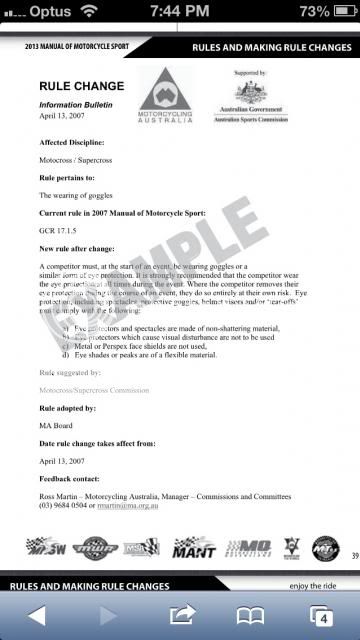
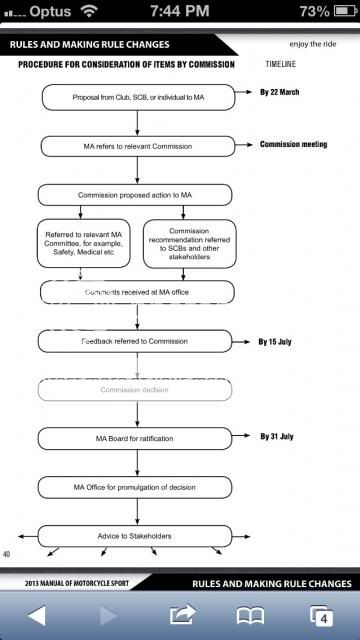

_________________
|
|
| |
|
|
|
|
|
|
|
|
ForeverThreeWheels
The Day Starts With OZATV !
Joined: 18 Nov 2008
Posts: 1742
Location: Maitland
|
| Posted: Sat May 11, 2013 9:29 pm Post subject: |
|
|
Proposed Inclusion into the MA Regs etc
2014 MANUAL OF MOTORCYCLE SPORT
** TRIKES
**.1 PROTECTIVE CLOTHING – TRIKES
**.1.0.1 Protective clothing and requirements
are as provided in the discipline specific
sections of the GCRs, clothing for Hill
Climb, Motokhana, Drifting and non-speed
related bitumen events must be as per
GCR?
**.2. FOOTWEAR IN PITS
**.2.0.1 Closed footwear must be worn in the pit
area at all times.
**.3 FRAMES AND PARTS - TRIKES
**.3.0.1 A trike must have:
a) 3 wheels,
b) A wheel at the front and on each rear corner of the machine,
c) The front wheel which is used
for steering and the rear wheels for
driving,
d) A maximum overall width, including
the rear tyres of 1500mm??? for
Speedway machines.
e) A seat for 1 person,
f) The rider straddling the seat,
g) A chain guard as per GCR 12.8.8,
(h) Heel guards are compulsory on
all trike machines.
i) A self closing throttle,
j) An engine cut-out switch, of lanyard
type attached to the rider’s body,
k) Effective brakes on all wheels,
l) Handlebars, rubber hand grips,
handlebar levers and number plates,
m) Noise emissions of no more than
94/96 dB(A) as measured in GCR
12.10. depending on the discipline,
n) No sharp or protruding extremities,
o) Glass, mirrors and headlights
removed.
NERF BARS???? Im unsure of adding this
h) A frame [Nerf Bar] between the front
and rear wheels which must:
i) Be of closed loop design,
ii) Not extend beyond a point of the
widest dimensions of the vehicle,
measured with a straight edge
touching the outside of the rear tyres,
iii) Be constructed to prevent the
riders feet from going below
the bars (material webbing is
acceptable),
iv) Be bolted or welded to the frame,
v) Be close enough to the rear wheels to prevent
locking together of competitors’
machines,
vi) Have no sharp, protruding tubing
either open ended or capped,
**.3.0.2 Mudguards which:
a) Must be fitted over the rear wheels,
b) May be fitted over the front wheels.
**.3.1 Tyres- Trikes
**.3.1.1 Rear tyres may be prescribed in the SR.
**.4 ENGINES - Trikes
**.4.1 Capacities - Trikes
**.4.1.1 The maximum engine capacity for a
2-stroke engined Trike shall not exceed
550cc, and be no more than 2 cylinders.
**.4.1.2 The maximum capacity for a 4-stroke
engined trike shall not exceed 700cc
for Stadium Classes, Dirt Track Classes,
Motorcross and Club Level Racing and
850cc for Enduro/Cross Country and Desert
Classes.
Sand Drags classes???
**.4.1.3 The actual engine capacity of a machine
competing in a capacity class is not
to exceed the prescribed capacity for
that class by more than 5% with the
exception of the 250cc two stroke class
and the 350cc 4 stroke class where no
engine displacement increase tolerance
is allowed.
**.5. RIDER AND MACHINE IDENTIFICATION
- TRIKES
**.5.1 Number plates are to:
a) Display numbers in contrasting White on Black colours with a minimum size
of 125mm height and 20mm width on the front.
b) Be mounted centrally at the front and
rear of the machine, rear fenders???
c) Not necessary for racing where
helmet colours are worn, such as
speedway.
**.5.2 For all MX competitions and any other
event that the Supplementary Regulations
specifically select this rule, no competitor
may compete unless wearing the machine
identification number on his or her back in
contrasting colours and with a minimum
size of 125mm height and 20mm width of
stroke.
**.6 FUEL - TRIKES
**.6.1 Fuel for all machines must:
a) Be Unleaded, and
b) Be no more than 100 RON, and
c) Contain no additives other than those
added at the point of manufacture
except for:
(i) Lubricating oil for 2-stroke engines
(ii) Upper cylinder lubricant for 4 stroke
engines.
d) Be readily available from retail petrol
pumps within Australia, or
e) Be a brand of fuel homologated by
MA that is compatible with the “Fuel
Quality Standards Act 2000”
I haven't really got this sorted yet. Input???
** TRIKES
207
2014 MANUAL OF MOTORCYCLE SPORT
**.7 CLASSES AND AGE GROUPS -
TRIKES
**.7.1 Trikes - Motocross and Club Level
Racing
JUNIOR CLASS(ES) RACING ???
SENIOR CLASS(ES) RACING
Open
Pro Skill Based
Intermediate Skill Based
Clubmen Skill Based
Women
Production
Vets 35+
Masters 45+
Jumbos
**.7.1.1 Pro
Australian Championship Class.
Championship status can only be awarded
if 8 or more riders start in the event. Race
duration for Championships - 15 minutes
plus 1 lap. Riders entering this class
cannot enter any other race class at the
same event. Event promoters can only
offer either Pro or Open (either one class
per event).
**.7.1.2 Open
Riders entering this class cannot enter any
other race class at the same event. Race
duration for Championship is 12 minutes
plus 1 lap. Event promoters can only offer
either Pro or Open (either one class per
event).
**.7.1.3 Intermediate
Australian Championship Class.
Championship status can only be
awarded if 8 or more riders start in the
event. This is a skill based class for
experienced riders. Race duration for
Championship is 12 minutes plus 1 lap.
**.7.1.4 Clubmen
This is a skill-based class. Recommended
race duration - 4 laps.
**.7.1.5 Women
Australian Championship Class.
Championship status can only be awarded
if 8 or more riders start in the event. Race
duration for Championships - 10 minutes
plus 1 lap.
**.7.1.6 Production
Standard, OEM as available through
Australian Dealer network. Machines must
satisfy **.3.0.1
Rider’s choice of:
a) Tyres to same specified dimensions
as OEM fitment.
b) Handle bar grip replacements to
OEM style.
c) Lubricants and fluids
d) Decals and sign writing
e) Drive chain and gearing changes
allowed
Recommended race duration - 5 laps.
**.7.1.7 Vets
Australian Championship Class.
Championship status can only be
awarded if 8 or more riders start in
the event. Age group 35+ years. Race
duration for Championships either 4 laps
or over 8 minutes in time.
**.7.1.8 Masters
Australian Championship Class.
Championship status can only be awarded
if 8 or more riders start in the event. Age
group 45+ years. Entrants can only enter
either Vets or Masters in any event. Race
duration for Championships either 3 laps
or over 6 minutes in time.
**.7.1.9 Jumbos
90cc 2 stroke and 125cc 4 stroke
Sub-Classes:
a) Jumbo:
i) Frame OEM
ii) Engine cases OEM or OEM
type (must be direct bolt on in
replacement utilising standard
engine mounts)
** Trikes
208
enjoy the ride
b) Outlaw
i) Sub class not scored
ii) Change of engine type allowed
iii) Jumbo class engine capacity limit
only.
Sub classes run together and may be
scored separately if minimum of 3 riders
in each class.
Recommended race duration - 3 laps.
**.7.2 Trikes - Stadium Classes (Arena Cross)
Open engine capacities as per **.4.1.1
and 22.4.1.2
**.7.3 Trikes - Dirt Track and Track Classes
Open engine capacity as per **.4.1.1 and
**.4.1.2
**.7.4 Trikes - Speedway
CLASS(ES) RACING
Open (Senior)
349cc to 700cc 4 stroke
124cc to 251cc 2 stroke
Race together
**.7.5 Trikes - Enduro/Cross Country, Desert
Classes
ENDURO/CROSS COUNTRY, DESERT ONLY???
** Trikes
**.7.7 Trikes - Sand Drags classes (off road)???
2014 MANUAL OF MOTORCYCLE SPORT
**.7.8 Trikes - Hill Climb classes
Pro
Up to ????cc
**.8 COMPETITION RULES - Trikes
**.8.1 Starting
**.8.1.1 Unless otherwise determined in the SR,
massed starts must be used.
**.8.1.2 The order and position of each competitor
will be at the discretion of the Promoter and
will be determined on the day of the event.
**.8.1.3 The starting grid for all MX and DT events
will:
a) Have not less than 2 metre space for
each trike,
b) Be in a straight line,
c) Allow for no more than 20 competitors.
**.8.1.4 The maximum number of starters must be
specified in SR.
** Trikes
**.8.1.5 Unless otherwise determined in the SR:
a) All competitors must be called to the
start line at least 2 minutes before
each start,
b) At the end of the 2 minutes, and when
the starter is ready, the starter will
hold up a 15 second sign for a full 15
seconds,
c) At the end of 15 seconds a 5 second
sign will be displayed,
d) The gate will drop between 5 and 10
seconds after the 5 second sign is
shown.
**.8.2 Finishing
**.8.2.1 The finish line must be:
a) Marked with a flexible post at each
side of the track,
b) Clearly visible to the judge.
This is just a rough draft. What do you guys think?
_________________
|
|
| |
|
|
|
|
|
|
|
|
waterdonk
50cc nipper
Joined: 31 Jan 2008
Posts: 44
Location: Newcastle
|
| Posted: Tue May 28, 2013 6:09 am Post subject: |
|
|
Going to have to dust the old girl off and fix my swingarm don't want to miss out on the next trip looks "profanity removed" awsome 
_________________
honda 70
Honda 86 250r |
|
| |
|
|
|
|
|
|
|
|
greenhuman
Roostin Away

Joined: 12 Feb 2006
Posts: 980
|
| Posted: Tue May 28, 2013 4:56 pm Post subject: |
|
|
| Ben, can u repeat your last post, I missed it LOL |
|
| |
|
|
|
|
|
|
|
|
Mart 300r
Roostin Away
Joined: 02 Jun 2008
Posts: 944
|
| Posted: Tue May 28, 2013 7:31 pm Post subject: |
|
|
So are you putting this forward mate??
Beau deffinately dust the old girl off you would have a ball up there ay.I need to rustle a few more ppl up.I dunno what it is but as soon as you mention speedway way they all seem to shudder its like they all get visions of the bad times they had like hitting walls back in the day lol.All the ol boy kept talkin about after we went up there was "All I was watchin was that bloody wall im not hitting that again" lol lol
I honestly felt safer out there flat out then I do flat out over Stockton all day.
When are we goin again guys???
_________________
1984 ATC 300R, 1986 TRX 500R,1984 ATC 200X, ATC 70 WITH CUSTOM LAYDOWN 250R ENGINE, 125CC CUSTOM THUMPSTER TRIKE |
|
| |
|
|
|
|
|
|
|
|
ForeverThreeWheels
The Day Starts With OZATV !
Joined: 18 Nov 2008
Posts: 1742
Location: Maitland
|
| Posted: Tue May 28, 2013 9:19 pm Post subject: |
|
|
| greenhuman wrote: | | Ben, can u repeat your last post, I missed it LOL |
Haha, yeah I was just scrolling through this page thinking, no one in their right mind is actually going to read all that.
I just needed to post it somewhere that I wouldn't lose it and I could copy and re paste it if need be at a later date.
I've got a lot on in June but after that I should be good.
That should also give Mart time to fix his top end and Beau and MUZZ their trikes.
Maybe first weekend in August?
Practice day is first Sat of the month.
Haven't put the proposal in yet mate, wanted you to read it through a couple times first to make sure all is good. Lol
_________________
|
|
| |
|
|
|
|
|
|
|
|
Mart 300r
Roostin Away
Joined: 02 Jun 2008
Posts: 944
|
| Posted: Tue May 28, 2013 9:25 pm Post subject: |
|
|
Yep im up for august ill b goin up for the weekend this time lol
_________________
1984 ATC 300R, 1986 TRX 500R,1984 ATC 200X, ATC 70 WITH CUSTOM LAYDOWN 250R ENGINE, 125CC CUSTOM THUMPSTER TRIKE |
|
| |
|
|
|
|
|
|
|
|
ozquad44
Roostin Away
Joined: 28 Feb 2006
Posts: 518
Location: QLD then VIC now WA
|
| Posted: Sun Jun 02, 2013 10:55 pm Post subject: |
|
|
Really impressive guys, after talking about it you went ahead and did it. Some great stills there.
I may have mentioned this some time back, but are you aware that MA had references to trike rules in their REG's all the way up to about 2000. I remember reading them in the MA manual when I got my first MA license.
_________________
State governments give us REC rego + area to ride ATVs legaly! State Status: VIC-No (Nazi's) QLD-Yes(no place to ride tho) NT-? NSW-Yes, Stockton. TAS-Yes, Areas for ATVs + ATV rego, Go Tazzie . WA-Yes, 2 top places within 1hr of Perth. ACT-? SA-No |
|
| |
|
|
|
|
|
|
|
|
|
|
|
|
|
|
You cannot post new topics in this forum
You cannot reply to topics in this forum
You cannot edit your posts in this forum
You cannot delete your posts in this forum
You cannot vote in polls in this forum
|
© 2001, 2002 phpBB Group
|
|
|


